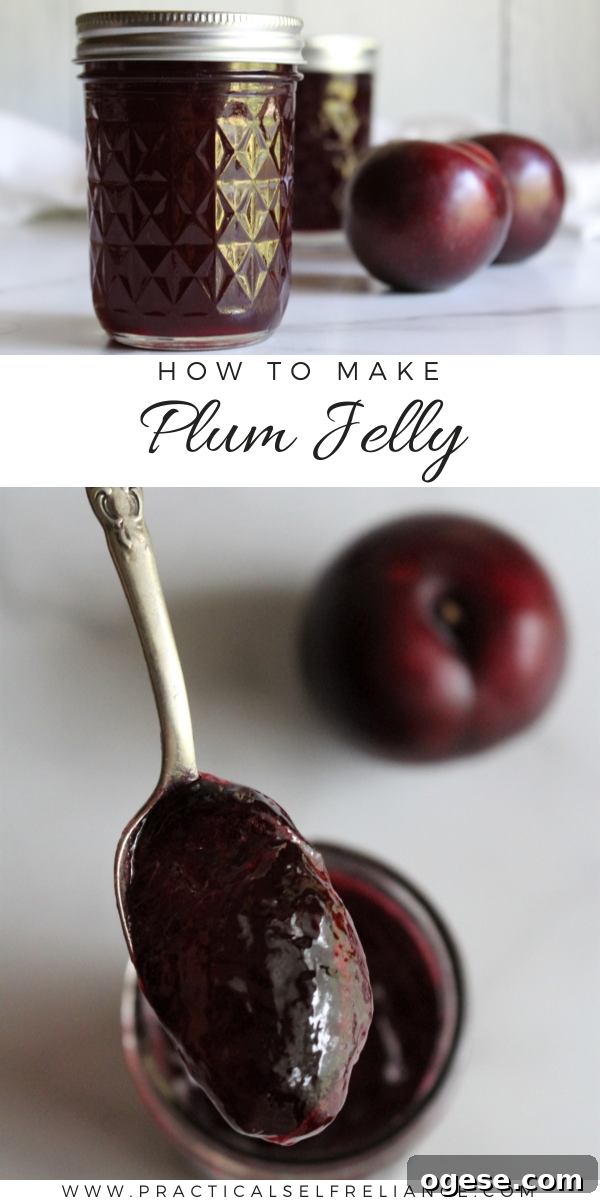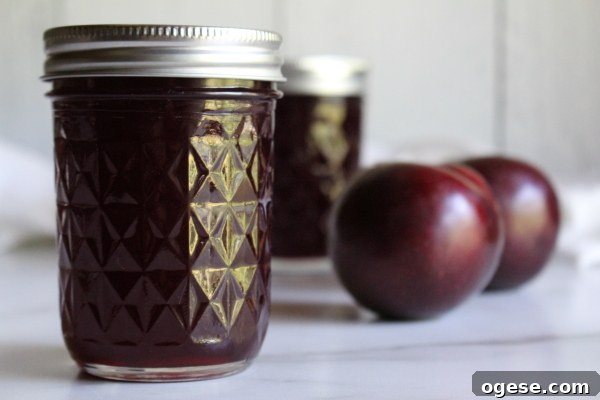
Plum jelly captures the full flavor of ripe plums in a smooth, skin-free preserve. Plums naturally contain ample pectin and acid, so this simple jelly needs just fruit and sugar—no added commercial pectin.
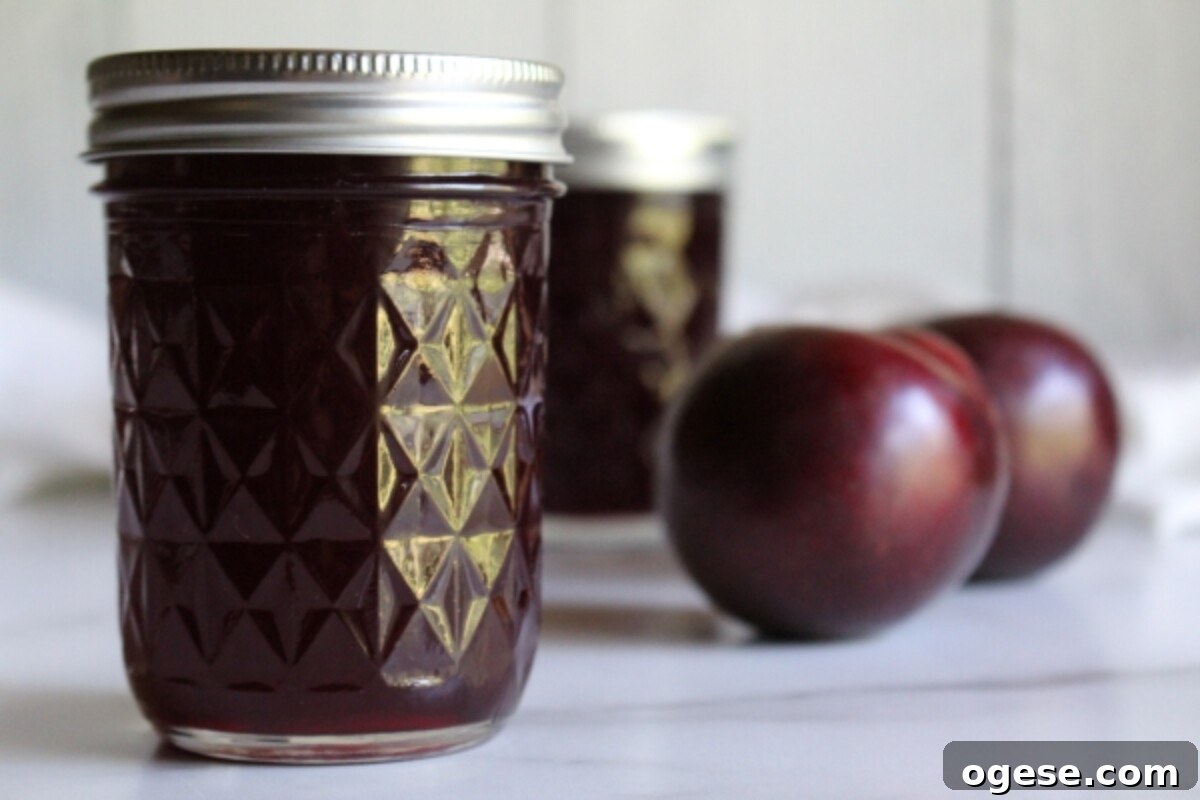
The age-old choice when preserving fruit: jam or jelly?
My kids always choose jelly—they love its glossy, spreadable texture. I enjoy plum jam with its large fruit pieces, but jelly is often the better option depending on the plums you have.
There are hundreds of plum varieties, each with different texture and flavor. Here are common reasons to make jelly instead of jam:
- Clingstone fruit – Some of the tastiest plums cling to the pit and are hard to pit cleanly. Jelly avoids the mess of removing every bit of flesh.
- Small fruit – Many homegrown plums are small, closer to cherries in size. Skipping pitting and making jelly is faster and easier.
- Bitter skins – Wild plums and damsons often have bitter skins. Brief cooking extracts color and flavor while the skins retain bitterness that’s removed during straining.
- Grainy or stringy plums – Some varieties become stringy when cooked. Straining out pulp leaves a clear, flavorful jelly without texture issues.
Plums supply plenty of pectin, especially in their skins. Simmering whole fruit and then straining yields a naturally setting jelly without commercial pectin. The result spreads easily yet holds its shape on a spoon.
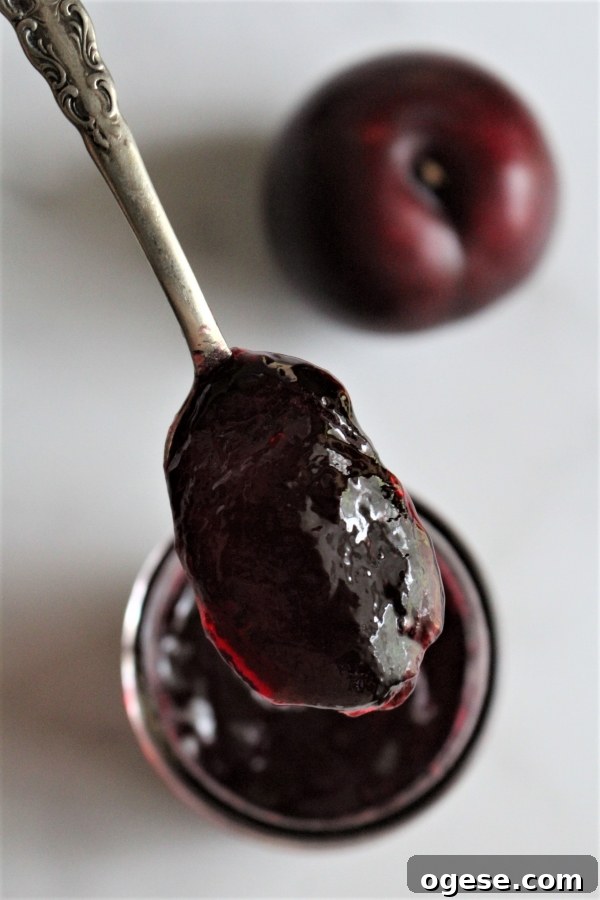
How to Make Plum Jelly
The first step is extracting plum juice by simmering the fruit—do not use a juicer. Simmering with the pectin-rich skins extracts the natural thickening agents needed for a firm set.
You don’t need to pit or peel the plums. If the plums are large, coarsely chop them to help them break down faster. If they are freestone and pit easily, you may remove pits, but leave skins in for color and pectin.
Add 1/2 cup water per pound of plums to a stockpot. Bring to a boil over high heat, then reduce to a simmer and cook 15–20 minutes or until the fruit has fully broken down.
Strain the mixture through a jelly bag or a fine-mesh strainer lined with two layers of cheesecloth. Allow it to drip for 1–2 hours or overnight until the pulp is fairly dry. Measure the juice once collected.
For each cup of plum juice, add 3/4 cup sugar. Bring juice and sugar to a hard boil in a deep saucepan and cook over high heat until the jelly reaches gel stage.
Gel stage is 220°F (104°C) at sea level. Subtract 1°F for every 500 feet of elevation. If you don’t have a thermometer, test for set by placing a spoonful on a chilled plate from the freezer and checking if it wrinkles when pushed.
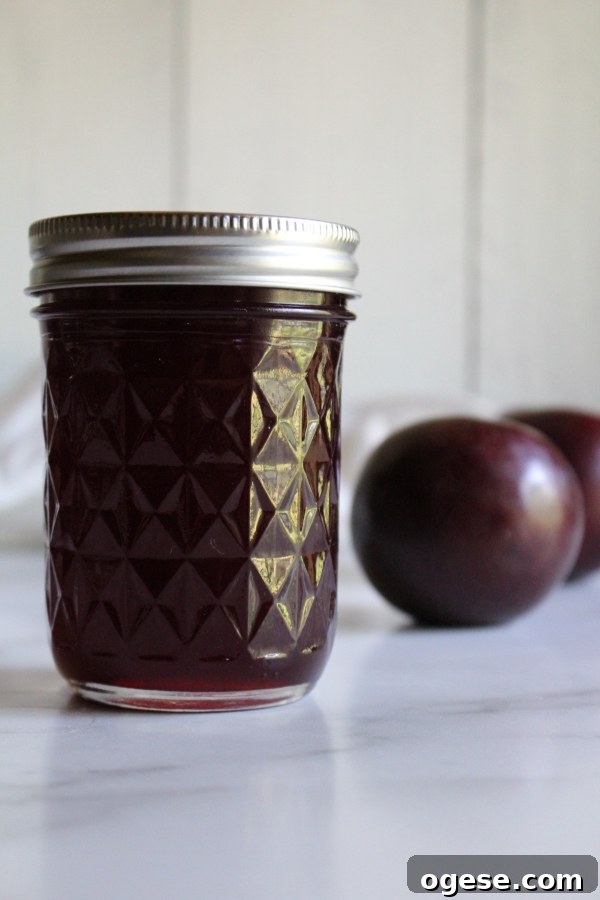
Plum Jelly Yield
Yield depends on plum variety and juiciness. With plump, juicy plums, expect about 3/4 to 1 cup of juice per pound of whole fruit when using 1/2 cup water per pound and simmering 15–20 minutes. Smaller or drier wild plums may yield 1/2 to 3/4 cup per pound.
For example, starting with 4 pounds of freestone, juicy plums (pitted) produced about 4 cups of juice. Using the 3/4 cup sugar per cup of juice ratio (4 cups juice and 3 cups sugar) yields roughly 3–4 half-pint (8 oz) jars of jelly.
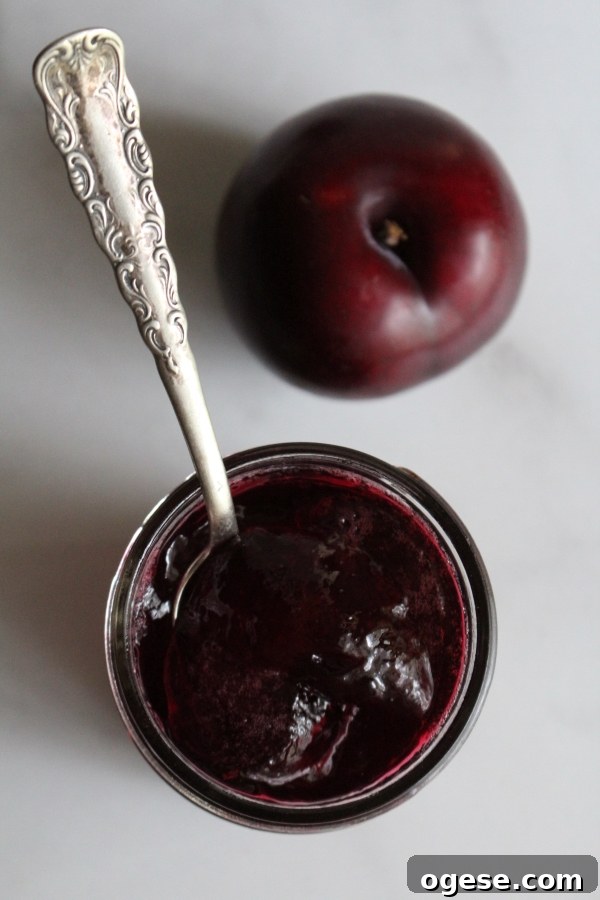
Plum Jelly Variations
The plum variety strongly affects color and flavor. Greengage jelly is light, sweet, and greenish; damson jelly is deep purple with rich, wine-like notes.
If you blend plums with other fruits, choose fruits with moderate to high pectin, such as apples, crabapples, red currants, hawthorn, chokecherries, cranberries, or citrus. Low-pectin fruits like cherries, strawberries, raspberries, peaches, and apricots may prevent the jelly from setting unless you add commercial pectin.
Flavor additions you can try:
- Balsamic roasted plum jelly – Roast halved plums with a sprinkle of sugar and a dash of balsamic until sugars caramelize, then proceed with the recipe.
- Spiced plum jelly – Simmer whole plums with a cinnamon stick, a few allspice berries, and a clove. After straining, swap about 1/4 cup brown sugar for part of the white sugar for a warm, complex sweetness.
- Vanilla plum jelly – Stir in scraped vanilla bean after straining for a soft vanilla note.
- Honey or maple sweetened jelly – Replace some or all sugar with honey or maple syrup, adjusting to taste and texture expectations.
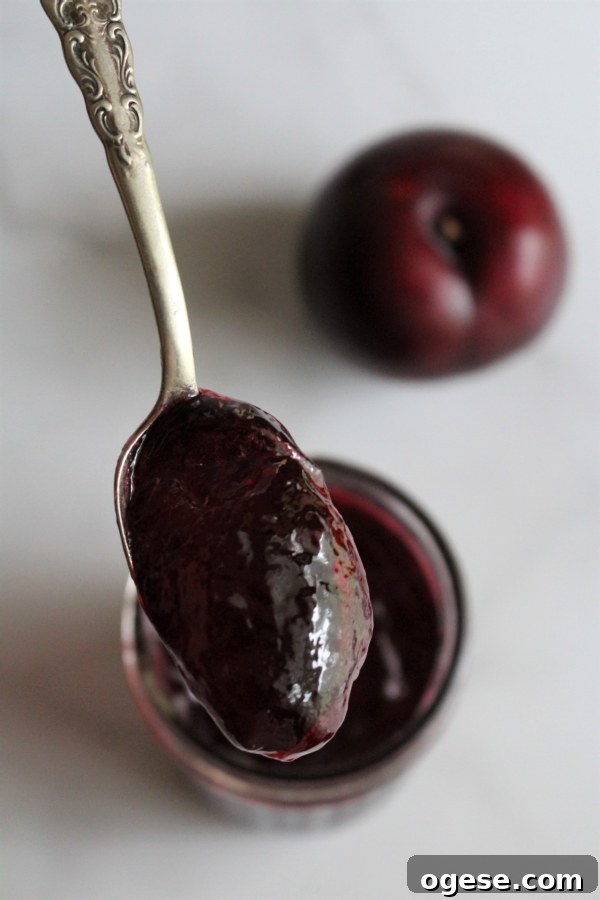
Canning Plum Jelly
You can store this jelly in the refrigerator or freezer without canning. For long-term pantry storage, water-bath canning is quick and simple.
Ladle hot jelly into clean jars leaving 1/4 inch headspace, wipe rims, remove air bubbles, and seal with two-part lids. Process jars in a water bath, adjusting for altitude. A 10-minute process time (for elevations under 6,000 feet) is commonly used and eliminates the need to pre-sterilize jars; above 6,000 feet, process for 15 minutes.
After processing, cool jars undisturbed on a towel for 24 hours, then check seals. Store unopened, properly processed jars on the shelf for 12–18 months. Refrigerate after opening. If not canned, refrigerate jelly for 3–4 weeks or freeze for up to 6 months.
Jelly can take 48–72 hours to complete its set. If it hasn’t set after three days, follow troubleshooting steps to rescue a soft or unset jelly—re-cooking with additional pectin or reheating to gel stage can help.
Other Ways to Preserve Plums
- Plum jam (chunky, fruit-forward preserve)
- Canning plums whole or halved
- Freezing plums for later use
- Dehydrating plums for snacks and baking
- Lacto-fermented or brined plum preparations
Plum Jelly
Equipment
- Water bath canner (optional)
Ingredients
- 4 cups plum juice (from about 5–6 lbs whole plums or 4–5 lbs pitted)
- 3 cups sugar
Instructions
Extracting Plum Juice for Jelly
- Wash and coarsely chop large plums, or leave small plums whole. Pit freestone plums if desired; leave pits in clingstone plums. Do not remove skins.
- Place plums in a stockpot with 1/2 cup water per pound of fruit (for example, 3 cups water for 6 lbs plums).
- Bring to a hard boil over high heat, then reduce and simmer 15–20 minutes until fruit collapses and breaks down.
- Remove from heat and strain through a jelly bag or a fine-mesh strainer lined with two layers of cheesecloth. Allow to drip 1–2 hours or overnight until pulp is fairly dry.
Making Plum Jelly
- Measure the juice. Add 3/4 cup sugar for every cup of juice (for example, 4 cups juice = 3 cups sugar).
- Bring juice and sugar to a hard boil in a deep saucepan. Cook over high heat until it reaches gel stage (220°F at sea level; subtract 1°F per 500 ft elevation) or use the chilled plate test.
- Ladle hot jelly into prepared jars, leaving 1/4 inch headspace. Wipe rims, remove air bubbles, and seal with two-part lids.
- If canning, process in a water bath canner for 10 minutes (below 6,000 ft) or 15 minutes (above 6,000 ft).
- Properly canned jelly keeps 12–18 months on the shelf. Refrigerate after opening. If not canned, refrigerate for 3–4 weeks or freeze up to 6 months.
Notes
Gel stage for un-pectin-added jelly is 220°F at sea level. Subtract 1°F for every 500 feet elevation (for example, 218°F at 1,000 ft).
This recipe scales: add 3/4 cup sugar for every cup of measured juice. For best results, keep batch sizes manageable (no more than 6–8 cups of juice per cooking batch) to ensure even heating and a proper set.
Nutrition
Nutrition information is an approximation.
Jelly Recipes
Try other easy homemade jellies:
- Grape jelly
- Strawberry jelly
- Blackberry jelly
- Peach jelly
- Pear jelly
- Dandelion jelly
- Wild violet jelly
Summer Canning Recipes
More summer canning ideas to put your canner to work:
- Canning peaches
- Canning strawberries
- Canning corn
- Canning peppers (hot or sweet)
- Canning green beans (raw-pack)
- Canning whole tomatoes
- Tomato sauces and salsas
- Canning zucchini